Pages

Wednesday, March 5, 2014

WPP #12: Unit O Concept 10: Angles of elevation and depression


http://t0.gstatic.com/images?q=tbn:ANd9GcSKvHvNZVc5F7PgZG2008OF-l9bI4BbhjA7zstukLMqiBMq8DVS:www.firstfoo.com/wp-content/uploads/2013/09/wedding-cake-beautiful-light-blue-quinceanera-cake-with-princess-character-on-top-quinceanera-cakes.jpg


The Problem: 15anera: Sugar, oh Honey Honey.

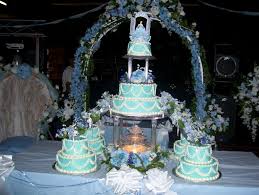
Marlene's cousin is about to celebrate her traditional quinceanera. She put Marlene in charge of the cake design. Marlene has a friend that works in a pastry and she meets with him to ponder over the design. However, one major issue she has is that they need to figure out how tall the cake should be. For aesthetic reasons, Marlene wants the corner of the table (where the cake will be placed) 25 inches away from the the edge of the top cake. She wants the table edge of the table to be 30 inches from quinceanera doll's eyes at the top of the cake. She wants the angle of the doll's eyes to the corner of the table plus the angle of the corner of the table to the edge of the top cake to be around 60 degrees. If they decide to make the cake 4 feet tall and put a 4 inch tall doll on top, find the angle of depression and elevation to see if 4 feet is close to getting the ideal angle that Marlene is thinking of.


Tuesday, March 4, 2014

I/D #2: Unit O Concept 7-8: Using the 30-60-90 triangle and using the 45-45-90 angle

30-60-90
To derive the pattern for the 30-60-90 triangles from an equilateral triangle with a side length of 1 we first need to know how an equilateral triangle is labeled. We have the information that it has the side length of 1, so since it is an EQUIlateral(meaning it has EQUAL sides) all three sides of the triangle will be one. Also, since it is equilateral triangle it means that its angles must be equal the same. This is when we absorb past knowledge about triangles. All angles of a triangle must equal to 180 when added. Therefore, in an equilateral triangle the angles will equal 60 each (60 times 3 equals 180). We can create two 30-60-90 triangle from an equilateral triangle by cutting it in half down the middle. We cut it in half down the middle first of all because we cut one of the 60 degrees angles of the equilateral into two 30 degrees, and second of all cutting a line straight down the middle will create two right angles, meaning they are 90 degrees (and now we have two 30-60-90).The lengths that the two 30 degrees angles are reflecting become 1/2 since we cut the equilateral triangle in half and its bottom side length of 1 is split to two halves. We see that the lengths reflected by the 90 degrees angles, the hypotenuse, are still.We do the Pythagorean Theorem, in relation to the special RIGHT triangles we have just formed, to get the side length of the line cutting straight down the middle. When we complete the Pythagorean Theorem we see that length is equal to radical 3 divided by 2. To get whole numbers for all our sides we multiply all the side values by 2, and the side reflected by the 60 degrees becomes radical 3, the side reflected by the 30 degrees becomes 1 and the side reflected by the 90 degrees becomes 2. We place the variable n in front of all these values to show that the pattern could be expanded. In other words, the length of 1 could be any other length, example 7, and the formula will still work.


http://t3.gstatic.com/images?q=tbn:ANd9GcSWUjC1X0IBBlOnbhexm2OgkwZW8m1w6N4IkOT6hzig-hn9nuvF:hs.doversherborn.org/hs/baroodyj/HonorsGeom/Class%2520Notes/Chapter%252011/Lesson11-5/EquilateralTriangle2.gif


45-45-90
We have a square with side lengths of 1. Since it is a square, all the four side lengths are equal to 1 and all the four angles will be right angles, meaning equal to 90 degrees. We cut the square diagonally to make two special right triangles of 45-45-90. (Two 90 degrees angles in the square are split to make four 45 degrees angles).Both sides reflected by both 45 degrees angles are still  length of 1 since we did not cut the square's side lengths and instead cut it through the middle diagonally.Now, this requires us to instead find the one missing length of the diagonal line, which represents the hypotenuse in the two special right triangles we formed. Again, we utilize the Pythagorean Theorem to find this missing value. When we complete the Pythagorean Theorem we find that the value is equal to radical 2. We label all the side lengths with the variable n because we show that the value could be expanded and the lengths do not have to equal 1 in order for the rules to work.


http://blog.powerscore.com/Portals/156640/images/satblog-5.jpg


        1. “Something I never noticed before about special right triangles is…that the 30-60-90 was derived from an equilateral triangle. Now all its measurements for its rule makes sense.
        2. “Being able to derive these patterns myself aids in my learning because…I am able to apply my knowledge so that when I do not remember exactly how the rules are for special right triangles, at least now I am able to know how to find them.

Friday, February 21, 2014

I/D#1: Unit N Concept after 6 and before 7: How do SRT and UC relate?

Special Right Triangles and the Unit Circle!

Heading for this Section Inquiry Activity Summary:

For the activity, we labeled the special right triangles.
For the 30 degrees triangle (which is the short one because it has the longer side down and the shorter side as its height) the hypotenuse/radius = r = 2x = 1 (because we are focusing on the Unit Circle which we know has a radius of 1). The short side (height) = y = x = 1/2, and this is because we divided r by 2x to make it equal 1 so we must also divide x by 2x to give it a value which is 1/2. the bottom side is x = x times radical 3 = radical 3 divided by 2. Given this information, we can also figure out the ordered pairs of this triangle assuming it is drawn out in the first quadrant of a graph. The point where the 30 degrees angles lies will of course be (0,0). Going to the next point lying on the x-axis, the ordered pair would be (radical 3 divided by 2 (x), 0). And the point lying above would be (radical 3 over 2(x), 1/2(y)). 


http://00.edu-cdn.com/files/static/learningexpressllc/9781576855966/The_Unit_Circle_30.gif


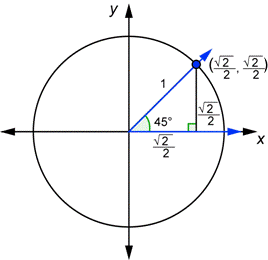
For the 45 degrees angle the values change, except the r remains = to 1. However, you must know that we got the value of 1 by dividing x radical 2 by x radical 2 because 45 degrees has different rule,according to the Special Right Triangle rules, the hypotenuse is x radical 2. not 2x like in the 30 degrees angles. The value for x and y are the same because they are the same length according to the rules of SRT. This value is radical 2 over 2 (let us set the y and x values as both x and they both become radical 2 over 2 when we divided the x by the hypotenuse value of x radical 2). The point where the 45 degrees lies will of course also be (0,0). Going to the next point lying on the x-axis, the ordered pair would be (radical 2 over 2 (x),0). And the point lying above would be (radical 2 over 2 (x), radical 2 over 2 (y)).


http://www.montereyinstitute.org/courses/DevelopmentalMath/COURSE_TEXT2_RESOURCE/U19_L1_T3_text_final_3_files/image036.gif


For the 60 degrees angle it is very similar to the 30 degrees angle. Just like the angles switch from where there were lying (as in the 30 degrees is no longer on the vertex point of the graph, instead now it is the 60 degrees angle opening), the values will switch too. This just means that x = 1/2 now and y = radical 3 over 2. r will continue to = 1. Meanwhile, the point where the 60 degrees angle lies now will of course be (0,0). The point lying on the x axis will be (1/2 (x), 0). And the point lying above would be (1/2 (x),radical 3 over 2 (y)).


http://00.edu-cdn.com/files/static/learningexpressllc/9781576855966/The_Unit_Circle_13.gif


This activity helped me to derive from the Unit Circle because I got a better understanding of where all the important values in the Unit Circle came from instead of just accepting them without expanded knowledge. Now I get a better sense of why and how we must learn many certain things in order for us to learn and understand others. This activity helped me have a better view of the 30, 45, and 60 degrees angles and fully comprehend the patterns that go along with them.

The triangles in this activity were all in the first quadrant but they may also lie on the second, third, and fourth quadrant, and refer to the degrees that they represent as reference angles. The number values of x and y do not necessarily change. Nevertheless, when we go from the first quadrant to the second one we will make sure that all the x values of each ordered pair of each angle are negative since the triangle is on the quadrant where the x-axis is negative while the y-axis is still going positive. On the third quadrant both the x and y values become negative and on the fourth quadrant only the y value becomes negative.

The below picture will give an example of how the 30, 60, and 45 degrees angles would look like in the quadrants II, III, and IV.


https://blogger.googleusercontent.com/img/b/R29vZ2xl/AVvXsEjBOzfx3dUOBGPrCKd12aLaE85rhswxJHDtn_zO-5usBtImcuEhiPG66Uo7w_FibbJWWa0Du17esK5BaD-Cw14-FEgOpdfDdDNrc6k1yZJr27s_88FRNv7t55RSrkjIK12HwCRyrb4OfUc/s1600/012.


The coolest thing I learned from this activity was that you can find the ordered pairs of those points of a unit circle. I never thought you can actually look at a point in a curved circle and know its ordered pair (like actual x and y values!)
This activity will help me in the unit because I will have a complete understanding of where and how to get the values of certain points in the unit circle. I will therefore, understand the sine, cosine, and tangent better since they have to do a lot with these angles and ordered pairs.
Something I never realized before about special right triangles and the unit circle is that the sides of the triangle are measured x and y for a purpose of showing us the ordered pair, I literally thought they were labeled like that just because. I also did not realize the connection between the SOH CAH TOA and the unit circle but now the abbreviations make actual sense.


 The Unit Circle at It's fullest!


http://t3.gstatic.com/images?q=tbn:ANd9GcR_fq7L0KBbyBoR514RtTD7Gf4NwC2FxBCPY-8S2EgBpovRuFj_:alvalxy.wikispaces.com/file/view/%25E6%259C%25AA%25E5%2591%25BD%25E5%2590%258D.jpg/306597904/%25E6%259C%25AA%25E5%2591%25BD%25E5%2590%258D.jpg




Tuesday, February 11, 2014

RWA: Unit M Concept 6- Hyperbolas

                                                                   Definition:
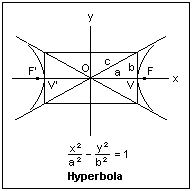
A hyperbola is a set of all points such that the difference in the distance from two points is a constant.

In a hyperbolas it matters which term (x or y) comes first in the equation because the equation of the hyperbola contains a minus instead of a plus like the ellipse. Therefore, the graph will look different based on which term (x or y) comes first.
The equation of the hyperbola can either be (x-h)^2/a^2 all minus (-!) (y-k)^2/b^2=1 or (y-k)^2/a^2 all minus (x-h)^2/b^2. Notice that the bottom terms (a and b) are not switched around and instead the a stays with the first term always and the b with the second term always. Also notice that when the x and y terms are switched the center values (h,k) also switch, meaning that the h value always matches the x value in the point and the k value always matches the y value in the point of the graph. DO NOT mix those two values when writing out the center for the graph.
http://t0.gstatic.com/images?q=tbn:ANd9GcTAP1wXzUwZiM2d8qshPZqrjVmj3GTa2FeHAOLsXfTbpKlsz5nr:mysite.du.edu/~jcalvert/math/hype1.gif
When x comes first in the equation you should already know that the graph will have the hyperbola going left and right. Also, this means that the transverse axis (main axis) is horizontal and for the vertices the x changes value and the y stays the same ((x,y) from the point of the center, which you get from (h,k)). Meanwhile, when y comes first in the equation the graph will have the hyperbola going up and down and the transverse axis will be vertical, meaning the vertices x will stay the same but the y value will change.
After figuring out these simple connections between the algebraic and graphic hyperbolas, it will be simple to discover other hyperbola elements such as the conjugate axis, the co-vertices and the foci. Remember that the foci of hyperbolas are outside the box drawn in the graph.
                    To have a better visual with the information given above please do not be a cheesebucket and check out video below:


                                                   REAL LIFE APPLICATIONS:
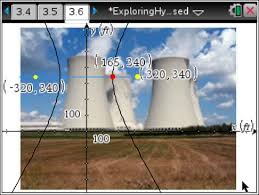
5. Cooling Towers of Nuclear Reactors - The hyperboloid is the design standard for all nuclear cooling towers. It is structurally sound and can be built with straight steel beams. When designing these cooling towers, engineers are faced with two problems: (1) the structutre must be able to withstand high winds and (2) they should be built with as little material as possible. The hyperbolic form solves both of these problems. For a given diameter and height of a tower and a given strength, this shape requires less material than any other form. A 500 foot tower can be made of a reinforced concrete shell only six or eight inches wide. See the pictures below (this nuclear power plant is located in Indiana). 

6. Stones in a Lake - When two stones are thrown simultaneously into a pool of still water, ripples move outward in concentric circles. These circles intersect in points which form a curve known as the hyperbola. 

Source: 
http://www-prod.pen.k12.va.us/Div/Winche...
http://t0.gstatic.com/images?q=tbn:ANd9GcQTbwo-QERHjE7sHXVRwPD7K_YE5lnNO3FSv2Nj0zuqhowGicuBSQ:education.ti.com/en/timath/~/media/Images/Activities/US/Math/Algebra%2520II/Exploring%2520Hyperbolas/ExploringHyperbolas3.jpg
To understand the picture above of the real world application for hyperbolas go ahead and check out the link below:
press here: http://www.pleacher.com/mp/mlessons/calculus/apphyper.html


Work Cited:


http://t0.gstatic.com/images?q=tbn:ANd9GcTAP1wXzUwZiM2d8qshPZqrjVmj3GTa2FeHAOLsXfTbpKlsz5nr:mysite.du.edu/~jcalvert/math/hype1.gif


http://t0.gstatic.com/images?q=tbn:ANd9GcQTbwo-QERHjE7sHXVRwPD7K_YE5lnNO3FSv2Nj0zuqhowGicuBSQ:education.ti.com/en/timath/~/media/Images/Activities/US/Math/Algebra%2520II/Exploring%2520Hyperbolas/ExploringHyperbolas3.jpg


http://www.pleacher.com/mp/mlessons/calculus/apphyper.html


<iframe width="500" height="375" src="http://www.schooltube.com/embed_force/2eec3f755fdc4a84a617/" frameborder="0" allowfullscreen="allowfullscreen" mozallowfullscreen="mozallowfullscreen" webkitallowfullscreen="webkitallowfullscreen"></iframe>


http://kirchmathanalysis.blogspot.com/p/unit-m.html

Monday, December 9, 2013

SP #6: Unit K Concept 10: Writing repeating decimal as a rational number using geometric sequence and series


  In this student problem you learn how to find the infinite sum of a repeating decimal using your knowledge of the geometric sequences and series.Therefore, you must first know that you can write a geometric sequence by breaking down the decimal portion. You must know that you find the common ratio of a geometric series by dividing a term by the one that precedes. After you have found the common ratio you must know how to write the geometric summation notation of infinite series and finally plug in the values of the infinite formula to get your infinite sum.
It is important to not forget the number before the decimal point (highlighted in yellow above). You must also include this "whole number" with whatever you got as the infinite sum of the sequence you created, so that you can have a complete right answer.