Pages

Showing posts with label SP. Show all posts

Tuesday, March 25, 2014

SP #7: Unit Q Concept 2: Find all trig functions given one trig function and a quadrant

The Picture below will show you a problem as well as how to find all trig functions using IDENTITIES (Reciprocal and/or Ration and/or Pythagorean). 


This problem shows that you can find all trig functions by using the identities that we learned about in Unit Q Concept 1. It shows that it is helpful to know these identities in order to have expanded knowledge that would help us solve problems that could become more difficult. It follows that it is a good practice to get to know the identities of trig functions out of the top of your head.
Please notice that we figure out the quadrant that will be used by checking the answers of the trig functions given, whether they are negative answers or positive answers. Also notice on the right how we figured out the answers of  each trig function, whether they were negative or positive, based on the quadrant that we found out will be used.


And please do not forget to to check out the SECOND WAY to find all the trig functions of this problem. Just click on:


                         Kathy's Awsume Second Way


Monday, December 9, 2013

SP #6: Unit K Concept 10: Writing repeating decimal as a rational number using geometric sequence and series


  In this student problem you learn how to find the infinite sum of a repeating decimal using your knowledge of the geometric sequences and series.Therefore, you must first know that you can write a geometric sequence by breaking down the decimal portion. You must know that you find the common ratio of a geometric series by dividing a term by the one that precedes. After you have found the common ratio you must know how to write the geometric summation notation of infinite series and finally plug in the values of the infinite formula to get your infinite sum.
It is important to not forget the number before the decimal point (highlighted in yellow above). You must also include this "whole number" with whatever you got as the infinite sum of the sequence you created, so that you can have a complete right answer.

Monday, November 18, 2013

SP #5: Unit J Concept 6: Decomposing Partial Fractions together with REPEATED FACTORS


In this student problem you will learn how to decompose a partial fraction with a factor that will be repeated at least once. This specific student problem will have three factors that are repeated. This type of decomposing is very similar to that of concept 5. In both you must separate the factors and put a variable (A,BC, etc,) as the numerator.
However,  you must remember when you separate these factors that are the same you must count up the powers. in the factor that is repeated on the denominator. This means that your first factor that is repeated will go to the power of one and then your second factor repeated to the power of two and so on.

SP #4: Unit J Concept 5: Decomposing Partial Fractions together


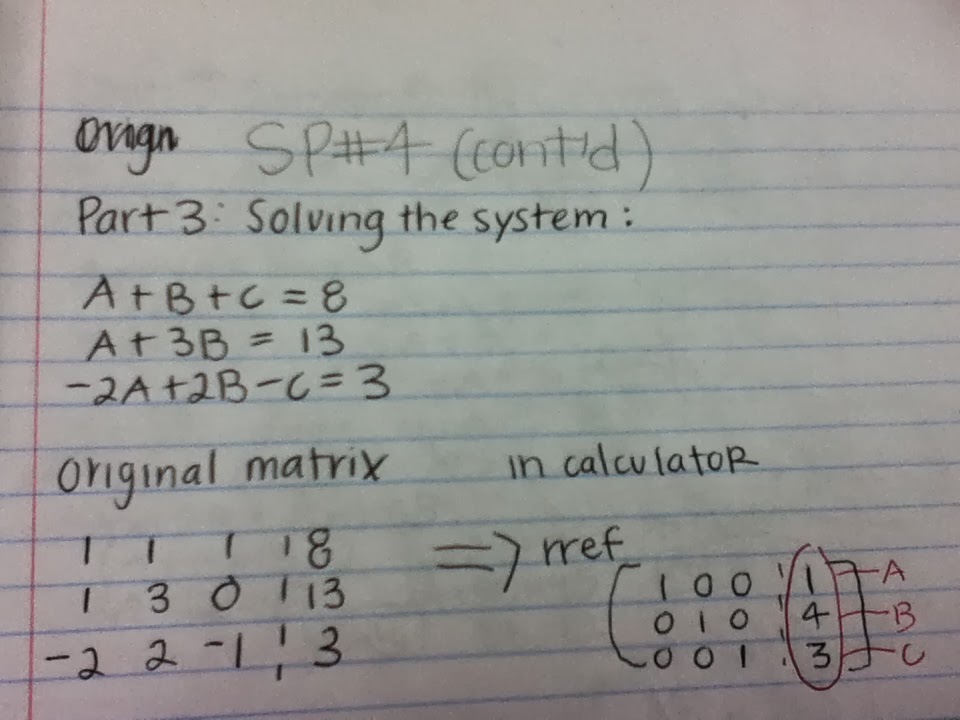
In this student problem you will learn how to compose and decompose partial fractions, which contain variable x on either the numerator or denominator or both. You compose them by adding them together as you would a normal fraction. In order to be able to add them together you must have the denominator the same. If you multiply the denominator by another number to make the denominators the same and add the numerators, you must also multiply the numerator by whatever you multiplied the denominator. When you DEcompose the fractions then you must separate the common denominator. You do this by separating each factor into different fractions and putting a variable (A,BC, etc.) as the numerator.
In this student problem you must remember to multiply the numerators by every factor needed in order to have the same common denominator and be able to add the numerators together. Also, when you decompose you must remember to gather the like terms together and not put different terms together in one equation of your system because then your answer will come out wrong.

Thursday, October 24, 2013

SP #3: Graph the exponential equation, filling out all needed parts


                             This problem shows how to graph exponential equation. It has the key parts we are already familiar with which are the a, b, and k values. The a value in this type of equation shows us at first sight whether the graph will be above or below the asymptote based on whether the value is positive or negative, and k value is the the y=k asymptote. In this equation k=1 so the asymptote is y=1 and since the the a value is positive the graph will be above this asymptote. You can also find other key parts to be able to graph this equation. These parts include: key points (you get from the calculator easily), the x and y intercepts, and the domain and range. Remember that the domain in an exponential equation will always be all real numbers while the range will be either from negative infinity to the asymptote or from the asymptote to positive infinity. In this case it is from 1 to positive infinity.
                            You must pay close attention to whether the graph will have or not have an x-intercept. You know whether the graph will have a x-intercept by knowing that if the equation leads you to getting the log (or natural log/common log in your calculator) of a negative then you cannot solve this equation and therefore there is no x-intercept. A short cut to knowing there is not or there is an x-intercept is by looking at the a and k values of the exponential equation. if they are both positives or both negatives values then the equation will not have an x-intercept like in this example. But if the a and k values differ in that one is negative and the other is positive then there will be an x-intercept.

Tuesday, September 17, 2013

SP #2: Unit E Concept 7

                  In this Student Problem we are first reviewing how to create a polynomial expression starting with the zeroes and their multiplicity. This is labeled 1 with a circle around it in the picture above. Then, the following step are numbered as well up until six. All the steps shown are taken to learn how to use information known to graph a polynomial. This information includes: how to find factors based on zeroes, how to multiply factors, how to interpret end behavior, how to solve for your y-intercept, and finally how to use the multiplicity number to know whether the line of a graph goes through, bounces, or curves.
                  In order to complete this student problem correctly you must remember that the zeroes are opposite of the factors so it will always be (x minus "zero"). Another key thing you must remember is how to know whether a line goes through, bounces, or curves using the multiplicity number. Mrs. Kirch's catchy tune of "1,2,3, TBC" is a good way to remember. If the multiplicity is 1, then the line goes Through, if it is 2 then the line Bounces, and if it is 3 the line Curves.

Wednesday, September 11, 2013

SP#1 Unit E Concept 1


                 In this student problem we are learning to change a standard form equation to a parent function form so we can easily find key points to make a graph. The key points include the vertex, which is either the maximum or minimum of a graph, the axis of symmetry, which is also known as the line of symmetry or simply the axis, and the x-intercepts. The y-intercept can also be found by the parent function but it is easier to use the standard form equation to find the y-intercept.

                   Something you need to remember is that since this is a quadratic equation, your graph must look like a parabola. The vertex can be either maximum, showing the parabola going down, or it can be minimum, showing the parabola going up. The axis can be used to write other points in the graph using the rule of symmetry. Finally, another thing you need to remember is that the x-intercepts can have radicals or they can even be imaginary numbers, which means the x-axis is not touched.