Pages

Showing posts with label I/D. Show all posts

Wednesday, March 19, 2014

I/D #3: Unit Q Concept 1: Rational Reciprocal and Pythagorean Identities

1. Where does sin^2 x+cos^2 x=1 come from to begin with?

To begin with. you should know that an "identity" is "a proven fact that is always true". Therefore, we assume that a Pythagorean Identity, which is the equation seen above, is called such because that equation can definitely be proven as a fact that is always true. Remember that the Pythagorean Theorem using variables x, y, and r is x^2+y^2=r^2. Now doesn't this look familiar? Yes, we did get it from the a^2+b^2=c^2 equation we've learned before, but notice that just by changing the variables to x, y, and r gives us the exact equation we learned that is of a unit circle.

Now let us play with this equation a little. Who knows what amazing discovery we will come across. If we wanted to set the Pythagorean Theorem (which we just found out is similar to the unit circle equation) equal to 1 as shown in the Pythagorean Identity above, what would we do to it? Oh, of course! Divide everything by r^2 because r^2/r^2 is equal to 1. We are left with x^2/r^2+y^2/r^2=1. You may think, what kind of mess is this? Well, do not fear, Math For Cheese Buckets, like you and me, is here to make it clear! First of all, you should know that the equation can be re-written as (x/r)^2+(y/r)^2=1

Moreover, the ratio of cosine is (x/r) and the ration of sine is (y/r). Wait, we've seen these before. Yes, a ton of times in the last 2 units, but wait a sec, we just saw them right now, in the re-re-written equation of the Pythagorean Theorem. We can look at the equation in the previous paragraph and switch the (y/r)^2 with sine^2 x and the (x/r)^2 with cosine^2 x. Guess that we did come across a discovery. We just derived the Pythagorean Identity from the Pythagorean Theorem. 

To show that this identity is true, we will choose one of the "Magic 3" ordered pairs from the unit circle.

  • 30 degrees= (radical 3 over 2, 1/2)
  • 45 degrees= (radical 2 over 2, radical 2 over 2)
  • 60 degrees= (1/2, radical 3 over 2
I will show 30 degrees and 45 degrees (know that 30 degrees is similar to 60 degrees, just switched).
  • 30 degrees: (radical 3 over 2)^2 + (1/2)^2 = 1. You cancel out the radical with the squared and end with just the 3 on the top of the first fraction. You square the 2 and end up with a 4 at the bottom of the first fraction, so you have 3/4. For the second fraction you square the 1 and still end with a 1 in the top of that second fraction, and you square the 2 to end up with a 4, so you have 1/4. (3/4)+(1/4)=1.
  • 45 degrees: (radical 2 over 2)^2 + (radical 2 over 2)^2 = 1. You can cancel out the radical with the squared for the top of both fractions to end up with a 2 on top of both fractions. Then, square the 2 at the bottom of both fractions and end up with a 4 at the bottom of both fractions: (2/4)+(2/4)=1.
2. Show and explain how to derive the two remaining Pythagorean Identities.

sine^2 x + cosine^2 x = 1. You divide the equation by cosine^2 x first. We know that sine x divided by cosine x equals tangent x by the Ratio Identities. So, we can "power up" through our understanding that it will be the same thing if we squared the sine and cosine we can square the tangent. The first part of the equation becomes tangent^2 x. Obviously, cosine^2 divided by itself is equal to 1. The second part of the equation is 1. On the right side of the equation 1 divided by cosine^2 x will become secant^2 x, because we know by the Ratio Identities that 1 divided by cosine x is secant x, therefore we can again "power up" to show that secant x will become secant^2 x. Our final equation: Tangent^2 x + 1 = secant^2 x.

The picture below can give you a visual. Please ignore the bottom part. Just pay attention up until the equation that is squared.


2.Jhttps://blogger.googleusercontent.com/img/b/R29vZ2xl/AVvXsEiDHvpTDOkgrgF25cX4WadLd509U46TFysmPmVoq8oK0KN0IxD0MwY4hDnLRII13ZhlSmX0MGhYvoses04nemL83rJuWro7hu1ftw0c0arJGg6nXItpORf5PT0IZCs5Ng1RTSH4az7p8Oyc/s1600/DSCN397PG


Now we divide the equation,  the one at the beginning of the top paragraph, by sine^2 x. Obviously, sine^2 x divided by itself is 1. Through the Ratio Identities we know that cosine x divided by sine x equals cotangent x. Again, we can "power up" to show that cosine^2 x divided by sine^2 x equals cotangent^2 x. On the right side of the equation we show that 1 divided by sine x equals co-secant x through the Ratio Identities, so once again we "power up" to know that 1 divided by sine^2 x will now equal co-secant^2. Our final equation: 1 + Tangent^2 x = Co-secant^2 x.


The picture below will give you the equations I am deriving the above work from.


l_idehttp://a2h-3rdhour.wikispaces.com/file/view/fundamental_identities.gif/140475861/fundamentantities.gif




Tuesday, March 4, 2014

I/D #2: Unit O Concept 7-8: Using the 30-60-90 triangle and using the 45-45-90 angle

30-60-90
To derive the pattern for the 30-60-90 triangles from an equilateral triangle with a side length of 1 we first need to know how an equilateral triangle is labeled. We have the information that it has the side length of 1, so since it is an EQUIlateral(meaning it has EQUAL sides) all three sides of the triangle will be one. Also, since it is equilateral triangle it means that its angles must be equal the same. This is when we absorb past knowledge about triangles. All angles of a triangle must equal to 180 when added. Therefore, in an equilateral triangle the angles will equal 60 each (60 times 3 equals 180). We can create two 30-60-90 triangle from an equilateral triangle by cutting it in half down the middle. We cut it in half down the middle first of all because we cut one of the 60 degrees angles of the equilateral into two 30 degrees, and second of all cutting a line straight down the middle will create two right angles, meaning they are 90 degrees (and now we have two 30-60-90).The lengths that the two 30 degrees angles are reflecting become 1/2 since we cut the equilateral triangle in half and its bottom side length of 1 is split to two halves. We see that the lengths reflected by the 90 degrees angles, the hypotenuse, are still.We do the Pythagorean Theorem, in relation to the special RIGHT triangles we have just formed, to get the side length of the line cutting straight down the middle. When we complete the Pythagorean Theorem we see that length is equal to radical 3 divided by 2. To get whole numbers for all our sides we multiply all the side values by 2, and the side reflected by the 60 degrees becomes radical 3, the side reflected by the 30 degrees becomes 1 and the side reflected by the 90 degrees becomes 2. We place the variable n in front of all these values to show that the pattern could be expanded. In other words, the length of 1 could be any other length, example 7, and the formula will still work.


http://t3.gstatic.com/images?q=tbn:ANd9GcSWUjC1X0IBBlOnbhexm2OgkwZW8m1w6N4IkOT6hzig-hn9nuvF:hs.doversherborn.org/hs/baroodyj/HonorsGeom/Class%2520Notes/Chapter%252011/Lesson11-5/EquilateralTriangle2.gif


45-45-90
We have a square with side lengths of 1. Since it is a square, all the four side lengths are equal to 1 and all the four angles will be right angles, meaning equal to 90 degrees. We cut the square diagonally to make two special right triangles of 45-45-90. (Two 90 degrees angles in the square are split to make four 45 degrees angles).Both sides reflected by both 45 degrees angles are still  length of 1 since we did not cut the square's side lengths and instead cut it through the middle diagonally.Now, this requires us to instead find the one missing length of the diagonal line, which represents the hypotenuse in the two special right triangles we formed. Again, we utilize the Pythagorean Theorem to find this missing value. When we complete the Pythagorean Theorem we find that the value is equal to radical 2. We label all the side lengths with the variable n because we show that the value could be expanded and the lengths do not have to equal 1 in order for the rules to work.


http://blog.powerscore.com/Portals/156640/images/satblog-5.jpg


        1. “Something I never noticed before about special right triangles is…that the 30-60-90 was derived from an equilateral triangle. Now all its measurements for its rule makes sense.
        2. “Being able to derive these patterns myself aids in my learning because…I am able to apply my knowledge so that when I do not remember exactly how the rules are for special right triangles, at least now I am able to know how to find them.

Friday, February 21, 2014

I/D#1: Unit N Concept after 6 and before 7: How do SRT and UC relate?

Special Right Triangles and the Unit Circle!

Heading for this Section Inquiry Activity Summary:

For the activity, we labeled the special right triangles.
For the 30 degrees triangle (which is the short one because it has the longer side down and the shorter side as its height) the hypotenuse/radius = r = 2x = 1 (because we are focusing on the Unit Circle which we know has a radius of 1). The short side (height) = y = x = 1/2, and this is because we divided r by 2x to make it equal 1 so we must also divide x by 2x to give it a value which is 1/2. the bottom side is x = x times radical 3 = radical 3 divided by 2. Given this information, we can also figure out the ordered pairs of this triangle assuming it is drawn out in the first quadrant of a graph. The point where the 30 degrees angles lies will of course be (0,0). Going to the next point lying on the x-axis, the ordered pair would be (radical 3 divided by 2 (x), 0). And the point lying above would be (radical 3 over 2(x), 1/2(y)). 


http://00.edu-cdn.com/files/static/learningexpressllc/9781576855966/The_Unit_Circle_30.gif


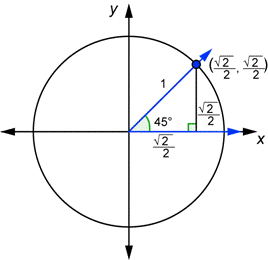
For the 45 degrees angle the values change, except the r remains = to 1. However, you must know that we got the value of 1 by dividing x radical 2 by x radical 2 because 45 degrees has different rule,according to the Special Right Triangle rules, the hypotenuse is x radical 2. not 2x like in the 30 degrees angles. The value for x and y are the same because they are the same length according to the rules of SRT. This value is radical 2 over 2 (let us set the y and x values as both x and they both become radical 2 over 2 when we divided the x by the hypotenuse value of x radical 2). The point where the 45 degrees lies will of course also be (0,0). Going to the next point lying on the x-axis, the ordered pair would be (radical 2 over 2 (x),0). And the point lying above would be (radical 2 over 2 (x), radical 2 over 2 (y)).


http://www.montereyinstitute.org/courses/DevelopmentalMath/COURSE_TEXT2_RESOURCE/U19_L1_T3_text_final_3_files/image036.gif


For the 60 degrees angle it is very similar to the 30 degrees angle. Just like the angles switch from where there were lying (as in the 30 degrees is no longer on the vertex point of the graph, instead now it is the 60 degrees angle opening), the values will switch too. This just means that x = 1/2 now and y = radical 3 over 2. r will continue to = 1. Meanwhile, the point where the 60 degrees angle lies now will of course be (0,0). The point lying on the x axis will be (1/2 (x), 0). And the point lying above would be (1/2 (x),radical 3 over 2 (y)).


http://00.edu-cdn.com/files/static/learningexpressllc/9781576855966/The_Unit_Circle_13.gif


This activity helped me to derive from the Unit Circle because I got a better understanding of where all the important values in the Unit Circle came from instead of just accepting them without expanded knowledge. Now I get a better sense of why and how we must learn many certain things in order for us to learn and understand others. This activity helped me have a better view of the 30, 45, and 60 degrees angles and fully comprehend the patterns that go along with them.

The triangles in this activity were all in the first quadrant but they may also lie on the second, third, and fourth quadrant, and refer to the degrees that they represent as reference angles. The number values of x and y do not necessarily change. Nevertheless, when we go from the first quadrant to the second one we will make sure that all the x values of each ordered pair of each angle are negative since the triangle is on the quadrant where the x-axis is negative while the y-axis is still going positive. On the third quadrant both the x and y values become negative and on the fourth quadrant only the y value becomes negative.

The below picture will give an example of how the 30, 60, and 45 degrees angles would look like in the quadrants II, III, and IV.


https://blogger.googleusercontent.com/img/b/R29vZ2xl/AVvXsEjBOzfx3dUOBGPrCKd12aLaE85rhswxJHDtn_zO-5usBtImcuEhiPG66Uo7w_FibbJWWa0Du17esK5BaD-Cw14-FEgOpdfDdDNrc6k1yZJr27s_88FRNv7t55RSrkjIK12HwCRyrb4OfUc/s1600/012.


The coolest thing I learned from this activity was that you can find the ordered pairs of those points of a unit circle. I never thought you can actually look at a point in a curved circle and know its ordered pair (like actual x and y values!)
This activity will help me in the unit because I will have a complete understanding of where and how to get the values of certain points in the unit circle. I will therefore, understand the sine, cosine, and tangent better since they have to do a lot with these angles and ordered pairs.
Something I never realized before about special right triangles and the unit circle is that the sides of the triangle are measured x and y for a purpose of showing us the ordered pair, I literally thought they were labeled like that just because. I also did not realize the connection between the SOH CAH TOA and the unit circle but now the abbreviations make actual sense.


 The Unit Circle at It's fullest!


http://t3.gstatic.com/images?q=tbn:ANd9GcR_fq7L0KBbyBoR514RtTD7Gf4NwC2FxBCPY-8S2EgBpovRuFj_:alvalxy.wikispaces.com/file/view/%25E6%259C%25AA%25E5%2591%25BD%25E5%2590%258D.jpg/306597904/%25E6%259C%25AA%25E5%2591%25BD%25E5%2590%258D.jpg